Showing posts with label Cornwall. Show all posts

Tuesday, June 9

Cornwall's Knockers: The Gnomes Who Toil The Tin Mines

Cornish tin mine

There are numerous stories about the Knockers who are said to populate Cornish tin mines. Here is one explanation taken from The drolls, traditions, and superstitions of old Cornwall by Robert Hunt (1807 -1887).

Charles Kingsley (1819-1875) posed the question: 'Who are the Knockers?' This was the reply:

One Saturday night I had retired to rest, having first seen that all members of the household had gone to their bedrooms. These were my daughters, two female servants and an old woman named Mary, who was left by the proprietor in charge of the house which I occupied.

I had some time in bed when I distinctly heard a bedroom door open and footsteps which, after moving about for some time in the passage or landing, from which the bedrooms opened, slowly and carefully descended the stairs.

I heard a movement in the kitchen below, and the footsteps again ascended the stairs and went into one of the bedrooms. The noise continued so long, and was so regularly repeated that I began to fear lest one of the children were taken suddenly ill. Yet I felt assured, if it was so, one of the servants would call me. Therefore I lay still and listened until I fell asleep.


On the Sunday morning, when I descended to the breakfast-room, I asked the eldest of the two servants what had occasioned so much going up and down stairs in the night. She declared that no one had left their bedrooms after they had retired to them. 

I then enquired of the younger girl, and each of my daughters as they made their appearances. No one had left their rooms - they had not heard any noises. 

My youngest daughter, who had been after this enquiry of mine for some minutes alone with the youngest servant, came laughing to me. "Papa, Nancy says the house is haunted and that they often heard strange noises in it."

So I called Nancy; but all I could learn from her was that noises, like men going up and down stairs, of threshing corn and 'beating the borer' (a mining operation) were not uncommon. We all laughed over papa's ghost during breakfast, and by and by old Mary made her appearance

"Yes," she said, "it is quite true, as Nancy 'as told you. I have often heard all sorts of strange noises; but I b'lieve they all come from the lode of tin which runs under the house. Wherever there is a lode of tin, you are sure to hear strange noises." 

"What, Mary! was it the knockers I heard last night?" 

"Yes, 'twas the knockers, down working upon the tin, no doubt of it."

This was followed by a long explanation, and numerous stories of mines in Leland and St. Ives district, in which the knockers had often been heard. 


After a little time, Mary, imagining I suppose that the young ladies might not sleep in a house beneath which the knockers were at work, again came with her usual low curtsey into the parlour. 

"Beg pardon, sir," says she, "but none of the young ladies need be afraid. There are no spirits in the house; it is very nearly a new one, and no one has ever died in the house."

This makes a distinct difference between the ghost of the departed and those gnomes who are doomed to toil earth's dark recesses.

Sunday, May 3

The Dream Precognition And The Double Hanging In Bodmin That 25,000 People Came To Watch

A different sort of post today copied from one of my old blogs. It features Bodmin Prison, a dream precogniton and a hanging watched by nearly 25,000 people. Here we go:

Captain Edmund Norway, the master of the merchant ship Orient, was situated seven miles off the volcanic island of St. Helena in the south Atlantic. 

On the 8th of February 1840 the Captain awoke with a start. He had been dreaming and told his second officer, Mr Wren, what he had dreamt: 


"I had a dreadful dream. I dreamt that my brother Nevill was murdered by two men on the road from Bodmin to Wadebridge (Cornwall). One fired a pistol twice, but I heard no report. He then knocked my brother from his horse, struck him several blows about the head, then ran away and left him."

Seeing his Captain was unsettled by this Mr Wren told him, "Don’t worry about it. You west country people are too superstitious." Captain Norway was from Cornwall, England. 

But it must have concerned the Captain as on February 9th, 1840 he took the trouble to record his dream, and the conversation with Wren, in the ship's log. 

Nevill Norway, a highly respectable timber and general merchant, was killed exactly as his brother had recorded and the murder caused considerable interest and discussion in Bodmin, Cornwall and the surrounding area. So much so that a police officer from London was sent to help with the enquiries.

Nevill had been seen on the day of the murder at Bodmin market and was carrying a considerable amount of money. It is thought he was seen by brothers, William and James Lightfoot, who were later arrested for Neville Norway's murder. They each initially blamed the other brother. 

William Lightfoot finally gave his version of what had happened:


"He and his brother had met by appointment, and were determined to have some money; that when Mr Norway came up, James snapped his pistol at him twice; that he (William) then gave him a blow with a stick; that he fell off his horse, and that James struck him with his pistol."

William and James Lightfoot were found guilty at the court and Monday, the 13th of April, 1840 was fixed for their execution by hanging at Bodmin Jail. 


The hanging became cause for almost a party atmosphere and 20-25,000 people went to watch the double hanging. This is how the local newspaper, The West Briton, reported the execution: 

"The execution of these wretched men (William and James Lighfoot) who murdered Nevill Norway, took place on Monday last, in front of the County Gaol.

The town of Bodmin on the Sunday evening presented the appearance of a fair, every Public House and as many private houses were filled to overflowing.

On Monday morning the road up to the prison was barricaded off from the public leaving a large open space below the drop which was occupied by the Sheriff's Javelin men and the local and special Constables.

People began to assemble very early in the morning and by twelve o'clock, the hour of execution, there could have been no less than from twenty to twenty-five thousand persons.

The prisoners were launched into eternity. They died almost immediately. The shoe of William, through the jerk, fell off.

After hanging for an hour, the bodies were cut down and put into a couple of black coffins. They were buried in a hole about three feet in the coal yard just in front of the prison.~ West Briton Newspaper 17th April 1840.
Is it any wonder the ghosts of William and James Lightfoot still haunt Bodmin Jail?

Sunday, March 10

5 POSTS ABOUT CORNWALL FROM MIKE'S CORNWALL BLOG


(1) THE COINCIDENCE MEETING AT BOSCASTLE

My wife and I had been away on a long weekend break. On the journey home we decided to take a longer, scenic route which took in the north coast of Cornwall. It got to about 11 o'clock and I saw the sign to the coastal village of Boscastle.

I asked my wife if she'd like to visit there, so we could have a tea or coffee while overlooking the sea. She couldn't make up her mind, but I took the turning anyway. When we reached Boscastle I drove into the only car park.

As it was out of the summer season the very large car park was virtually empty, so we found a spot to the middle of one side. As we parked another car stopped directly behind us about four rows back ...


For full post click: The Coincidence At Boscastle


(2) MARAZION AND THE MAGICAL ST.MICHAEL'S MOUNT

We were in the Marazion and Mounts Bay area yesterday. The main attraction, in my opinion, being St. Michael's Mount. I find it very magical. Unfortunately it isn't open during the winter months so had to admire from afar.

There are numerous stories linked to St. Michael's Mount such as :

(1) It is said that the Archangel Michael appeared before local fisherman on the mount in the 5th century ...


(3) A FLAVOUR OF CORNWALL'S EDEN PROJECT: 15 PHOTOS

We went to Cornwall's Eden Project yesterday. It was a funny old day weather-wise, there was hail stones, blue sky and even a few dark clouds, but it was all very pleasant. Today's post, therefore, simply consists of 15 photos snapped as we walked ...


(4) THE 500 PLUS YEAR OLD BRIDGE IN ST.AUSTELL

On the outskirts of  St.Austell town there is a very old bridge that is rarely given a second glance. It no longer carries traffic, other than perhaps a few bicycles. This is a shame because the bridge is well over 500 years old 


(5) THE MYSTERIOUS ROCHE ROCK CORNWALL

s the evening shadows fall on Roche Rock, and it's tiny chapel, the wind howls heartily over the heath-land. It is definitely not a place for the faint-hearted. The ghost of an old tin miner casts his shadow with no earthly presence to be seen ... gulp ...

For  full post click : The Mysterious Roche Rock, Cornwall

Friday, January 6

The Magic Of Changelings And Cornwall's Men-an-Tol Stones

Men-an-Tol Cornwall

The photo above is of the Men-an-Tol stones in Cornwall, sometimes referred to as the Crick Stone or the Devil's Eye. They are said to have magical properties.

Some say they have a fairy or pixie guardian who can make miraculous cures. In one case a changeling baby was put through the hole in the stone in order for the mother to get her real child back. Evil pixies had exchanged her child, and the ancient stones were able to reverse their spell.

Changeling babies are often mentioned in ancient tales. They are typically described as being the offspring of a fairy, elf or other legendary creature that has been secretly left in the place of a human child.

A changeling may seem a fanciful idea but one was locked up in Cornwall's Bodmin Old Prison in the 1600s. Her name was Anne Jeffries and she was born in St Teath, Cornwall in 1626. Being a supposed changeling she had legendary healing powers - and this is why she was locked up in prison!

Ann Jeffries was kept in Solitary Confinement for six months, and not given any food. The strange thing is, she was not affected by this in any way. Her health and weight were maintained She insisted that she was fed and cared for by the fairies in her cell at night. 

Ann, however, never described herself as a changeling. It is described in an old letter how her powers came about - from first seeing fairies. A quote from the letter (in old English):

In the Year 1645, (she then being nineteen Years old) she being one day knitting in the Garden, there came over the Garden-hedge to her (as she affirmed) six Persons of a small Stature, all clothed in green, which she called d'Fairies: upon which she was so frighted, that she fell into a kind of a Convulsion-fit: But when found in this Condition, we brought her into the House, and put her to bed, and took great Care of her. As soon as she recovered out of her Fit, she cries out, "They are just gone out of the Window; they are just gone out of the Window; do you not see them?" 

Source: The letter was from a Moses Pitt to the Right Reverend Father, Dr. Edward Fowler, Lord Bishop of Gloucester.

Okay, got side tracked! Lets get back to the Men-an-Tol stones.


Men-an-Tol
Men-an-Tol means, in the Cornish language, 'stone and hole' which very much describes what it is, as can be seen from the photo.

The stones are believed to be from the Bronze age and, if this is correct, would mean they are over 3500 years old. As to what they actually are or signify is debatable. They may once have been part of a circle of stones - which would have given it a ritual significance - or alternatively they could have been part of a burial chamber - the hole being for access.

These ancient stones have much folklore attached to them and are said to have a fairy or piskie guardian who can carry out various cures. With the obvious feminine symbolism it is claimed that if, at a full moon, a woman passes through the hole backwards seven times she will become pregnant.

Men-an-Tor is said to heal many ills. It was famous in olden times for curing scrofula (lymphatic tuberculosis) and rickets in children. The children were passed naked three times (or some say nine) through the hole to effect the cure. Adults can gain relief from bad backs by crawling through the opening nine times. Radiation levels around the inside edges of the hole are said to be nearly twice that found in the background environment, maybe this has some significance.

The stones have been used for telling the future. In 1856 Robert Hunt wrote that the holed stone could answer any question. Two brass pins would be laid crosswise on top of each other on the stone and would move by themselves, dependent of the question asked.

Rituals may also have once been taken place here, with the hole aligning to other ancient sites, or as a window into other worlds or dimensions. It has also been suggested that passing through the stone could have signified a ritual re-birthing process, perhaps performed as a rite of passage or to ensure fertility.

Whatever mysteries the stones hold, it is a magical place.

Other Random Posts:
Top 10 Coincidence And Synchronicity Stories
Doppelgangers On The Loose!
The White Dove As A Messenger Of The Dead


More Photos of Cornwall on "Mike's Cornwall" Blog

Bookmark and Share

Sunday, April 10

The Google+ Photo And Painting Coincidence

Lerryn, Cornwall

Since I joined Google + I have been using the above photo on my profile page, as can be seen below.

Mike Perry's Google + Profile Photo

Then a few weeks back, out of the blue, someone sent my wife and I a card. They don't know anything about my Google+ Page or anything else I do on the Internet, and they live in another part of the UK. The coincidence is that the picture on their card is a painting of the very same scene as on my profile page. The only difference is that in my photo it was high tide and in the painting it is low tide.

Painting of Lerryn, Cornwall

Of all the cards or pictures they could have sent they chose this one! I wonder why?!

You can see my Google+ Page and Photo Collections here.

More posts on Cornwall on Mike's Cornwall Photos

Other Random Posts:
Coincidence Meeting At the Raffles Hotel Singapore
Write Home To Mother Coincidence
The Unusual Contact With Her Dead Mother

Bookmark and Share

Thursday, December 17

Cornwall's China Clay Industry: 6 Photos

Washing china clay Cornwall

It's quite a while since I have done a Cornwall post for this blog, so that's what this is today - but not the normal sea and sunshine photos I usually publish. Today's six photos are from Cornwall's China Clay Industry.

China Clay was once very big business, and half of the world's supply came from Cornwall in the late 1800s. Since then it has somewhat declined but there is still clay being produced.

China clay workers Cornwall
Clay Workers Figures Outside of the Wheal Martin Clay Museum
China Clay quarry Cornwall
An old China Clay Quarry, now being returned to nature
China Clay Drying Sheds Cornwall
The sheds where China Clay was once dried before being transported
Crane used in Cornish chine clay industry
Once used for lifting purposes
Lee Moor No.1 train used in China Clay industry
The Lee Moor No.1 used to transport clay to Plymouth
Other Random Cornwall Posts:
The Magic Of King Arthur And Tintagel Castle Cornwall - 21 Exclusive Photos
The Ghosts Who Haunt Bodmin Jail, Cornwall: 13 Exclusive Photos
Magical Walk With Daphne Du Maurier To The Gribbin

New Blog: Mike's Cornwall

Bookmark and Share

Monday, April 6

Walking The Roseland Peninsular And Jesus Visiting Cornwall

St Mawes Castle, Cornwall

We went walking on the Roseland Peninsula in Cornwall. The name comes from the Cornish word Ros meaning promontory, rather than from the flower.

St Mawes Castle, Cornwall

We stopped off at St Mawes castle, built in the time of King Henry VIII to protect the Cornish and English coast. We continued walking alongside the River Fal - a lovely day with blue skies of varying shades.

River Fal, Cornwall

We also looked in on my favourite church at St. Just. This is where it is said that Jesus may have visited as a young man - see:

The Mystery Of Jesus Visiting Cornwall In England
Why Jesus Visited Cornwall In England
Did Jesus Visit St George's Island Looe Cornwall

New Cornwall Blog: Mike's Cornwall

Bookmark and Share

Saturday, March 14

Walking The Cornish Coast Looking For Tin Mines

Chapel Porth

On Tuesday, the forecast was good. Sunshine was promised so we decided to go for a walk along Cornwall's coastal path.

We started out at Chapel Porth on Cornwall's north coast, had a look at the beach (above) and then took to climbing up the cliffs via a footpath.

Cornwall's coastal path from Chapel Porth

The footpath signs showed the way - not that you can really get lost following the coast. Amazingly though we only saw two other people on our walk. I guess nobody believed the weather forecast after all of the rain and wintry conditions we have had recently.

Footpath

We soon had the old Wheal Coates tin and copper mine in sight. It's hard to believe that this would have once been a busy industrial scene. Now the area has been left to Mother Nature.

Wheal Coates tin mine, Cornwall

The tin mines are a symbol of Cornwall, once tin was exported, along with copper and other minerals all over the world.

Tin

The chimney stack still rises high and proud ...

Wheal Coates tin and copper mine

... as it looks out on the Atlantic Ocean. We carried on our walk into the afternoon sustained by traditional Cornish pasties - though mine was a vegetarian pasty. A perfect day!

Atlantic view from Cornwall coast path

Other Random Cornwall Posts:
The Magic Of King Arthur And Tintagel Castle Cornwall - 21 Exclusive Photos
Magic Of The Fowey Hall Walk Where King Charles I Narrowly Escaped Death - 30+ Exclusive Photos
A Cornish Journey Back To 1644 At Restormel Castle

For more Cornwall Photos: Mike's Cornwall Photos

Bookmark and Share

Friday, March 13

Synchronicity In The Air In Cornwall

RAF Davidstow Moor Memorial Museum
Here's a story from 67 Not Out reader Billhook. He mentions two previous posts: The Magic Of King Arthur And Tintagel Castle Cornwall and Coincidence Of The Two Flying Fortress Airmen From Ludington - you will see how these fit into his story.

"Just read your thread on Cornwall and the bit about King Arthur's Castle. Before that I had been reading the story of the two Flying Fortress Airmen and their synchronicity.

My mother was a Wren at Treligga [in Cornwall] where she was marking targets for Typhoons as they practised rocket firing. Father was in Coastal Command at Davidstow Moor [also in Cornwall] flying Warwicks and they met in the bar at King Arthur's Castle hotel.

Mother always tells the story of how one misty day a Flying Fortress came to the airfield at Treligga with its wheels down to attempt a landing. Really the grass strip was only a 500 yard emergency landing field for the Typhoons in case anything went wrong with the rocket tests.

The leading Wren went out with a Very light to ward him off but the plane landed, quite easily I believe as it was a tail dragger. The Wrens went out to greet the plane but the American crew aimed their guns at them as they thought they had landed in France!

The next day they took every bit of excess weight off the plane, guns ammo,bombs and flew with just a pilot and navigator. There was a holding of breath when it disappeared over the cliff and a sigh of relief when it climbed into view again.

Exactly the same thing happened with another lost Fortress on the same day a year later.

Mother still has the newspaper cutting.

I went to visit some friends in Rock [Cornwall] last summer and we thought we would go and have a look at father's old base at Davidstow..to my great surprise there is a museum there and there is a hangar dedicated to the Wrens of Treligga and on the wall is a picture of my mother aged 17 loading a volunteer on a stretcher into an ambulance!

A lot of synchronicity in the air around there I think!"

My thanks to Billhook.

For more Cornwall Photos and Posts: Mike's Cornwall

Bookmark and Share

Friday, February 27

Glimpses Of Cornwall

Truro River, Cornwall

More glimpses of Cornwall today. Above is the Truro River and on a cloudy late afternoon. And below the tide is out on a grey-day at Pentewan Beach leaving the green cladded rocks exposed.

Pentewan, Cornwall

Menabilly, Cornwall
Menabilly, Cornwall - Du Maurier Country"
The ponies below roam free on Bodmin Moor, Cornwall often gathering together in groups - some can get quite frisky!

Ponies on Bodmin Moor

And finally part of the Cornwall section of the South-West Coast Path. I took this photo from Gribbin Head. A lovely place for walkers.

Cornwall coastline

More Glimpses of Cornwall here and here or enter Cornwall into the search box at the top of the blog for many posts on Cornwall.

More Photos & Posts of Cornwall on Mike's Cornwall

Bookmark and Share

Saturday, February 21

Glimpses Of Cornwall

Photos I have snapped of Cornwall, where I live.

Below, the small village of St. Clement in Cornwall, situated in the valley of the Tresillian River.

St Clement, Cornwall

To show that everything isn't perfect in Cornwall, a rusty fence post. In the background is a brick built bridge which the London to Cornwall train crosses several times a day (and Cornwall to London, of course!)

Railway bridge, Cornwall

An old Notice from 1894 showing various shipping charges for the Fowey River, Cornwall. 


1894 sign for shipping charges in Cornwall

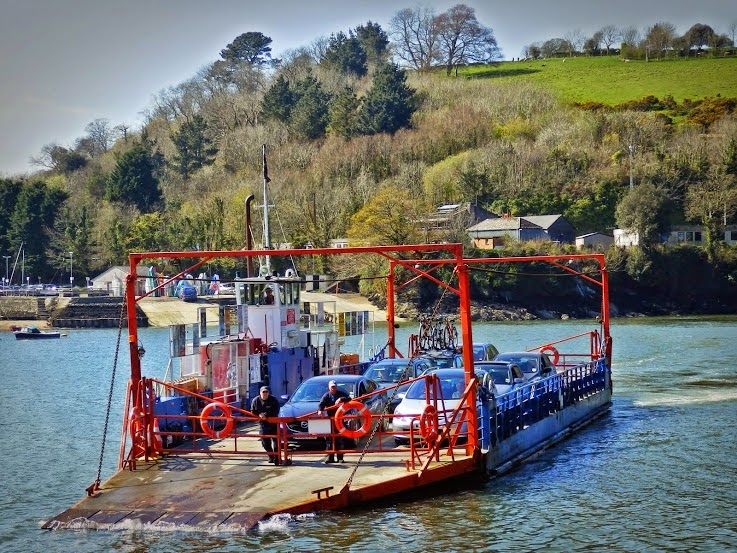
The Bodinnick ferry which travels across the Fowey River from Bodinnick to the town of Fowey and return. Carries cars and foot passengers. 

Bodinnick Ferry, Cornwall

The wonderful Minack Theatre at Porthcurno, Cornwall. An amazing venue to enjoy a play, with the sea and cliffs as a backdrop - in the summer, of course!


More Cornwall photos on Mike's Cornwall

Bookmark and Share